
Lemaître
L’Univers n’est pas trop grand pour l’homme, il n’excède pas les possibilités de la
science ni la capacité de l’esprit humain
The Universe is not too large for humankind, it does not exceed the capabilities of
science nor the abilities of the human mind
Georges Lemaître (1894-1966)
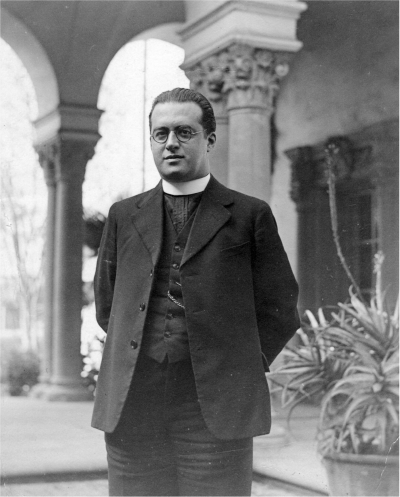
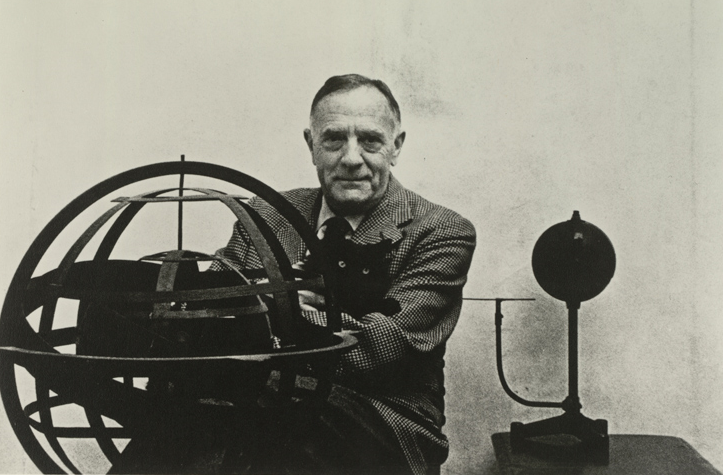
Monsignor Georges Lemaître
© Archives Georges Lemaître, UCLouvain
Monsignor Georges (Henri Joseph Édouard) Lemaître, born in the City of Charleroi on July 17, 1894, passed away in the City of Leuven on June 20, 1966, and has since been laying in the family vault at the Marcinelle Cemetery. Throughout his life, Georges Lemaître remained deeply attached to his native homeland and to his family roots in the Black Country of Charleroi.
Monsignor Georges Lemaître, professor from 1925 until 1966 within the French speaking section of the then unitary Université Catholique de Louvain, is unanimously recognised today as the founder of modern physical cosmology and the theory of the Big Bang. He was a great scientist and visionary physicist of the twentieth century, universal, European, Belgian, from the City of Charleroi, and besides many other original scientific contributions, gave the Universe its cosmological history.
Constantly pursuing along his two paths of a personal quest towards Truth, all his life long Georges Lemaître also remained faithful to his priestly vocation, having been ordained to the priesthood in 1923. From 1936 until his death, he was a member of the Pontifical Academy of Sciences, of which he also assumed with visionary openness as well the Presidency from 1960 to 1966.
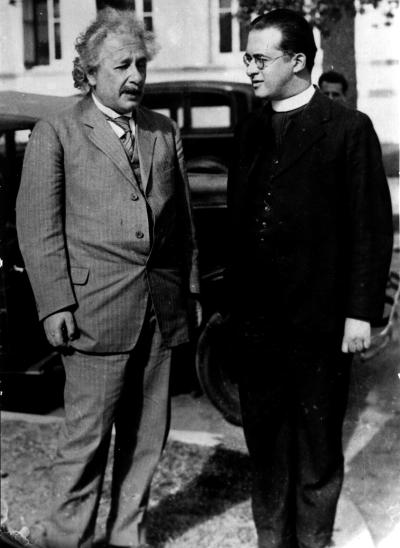
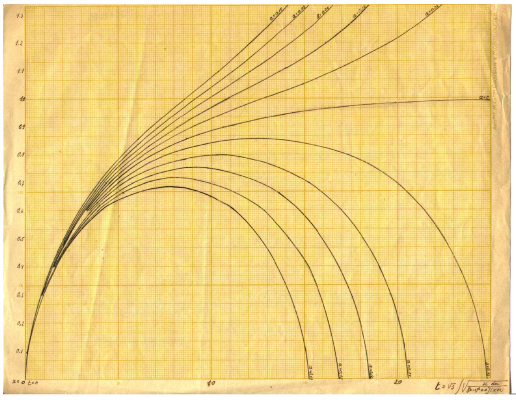
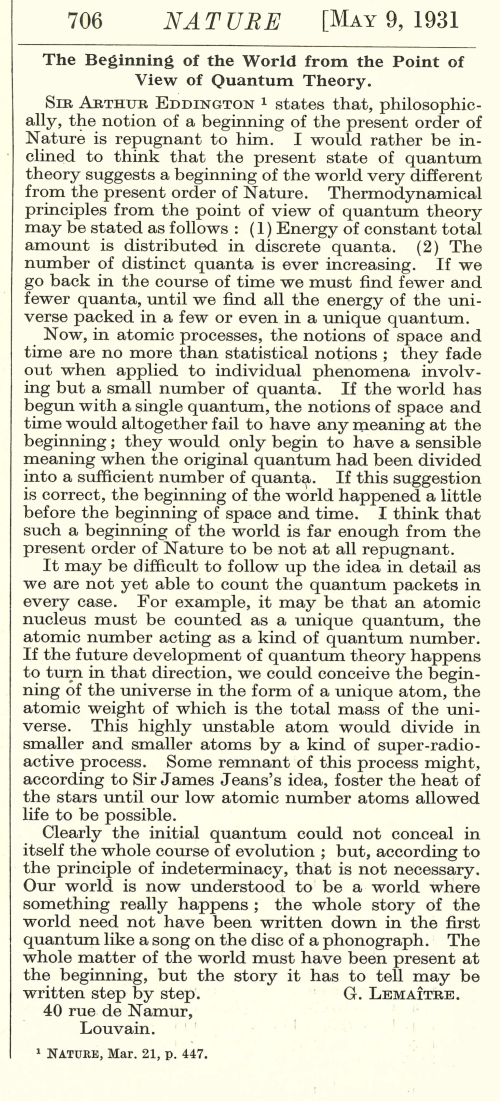
It was during the years 1927 to 1933, while living and working in the College of the Holy Spirit in Leuven, that Monsignor Georges Lemaître laid the foundations of his theory of the Universe, often referred to as the theory of the Big Bang, constructed within the framework of the then most recent theory of gravitation and General Relativity by Albert Einstein. In a first stage, in 1927, with the proposal that the Universe is in fact expanding; and in a second stage, in 1931 and 1933, with the hypothesis of the so-called “primeval atom”, proposing the sudden emergence of time and space out of a singular and intrinsically quantum physical state, at “That unique moment, that knew no yesterday” (“Cet instant unique, qui n’avait pas de hier”). This major scientific legacy, indeed still most topical today, was recognised already in 1934 by the most prestigious of the Belgian scientific distinctions, the Francqui Prize, and by many other international scientific distinctions to be awarded in the years thereafter.
The Hubble-Lemaître Law
Against the prevailing beliefs of all at the time including Albert Einstein’s, in 1927 Georges Lemaître proposes that the Universe is in fact expanding, and therefore certainly neither immutable nor static. One of the direct observational consequences of this expansion is the phenomenon of the recession of galaxies – indeed already in 1927 Georges Lemaître predicts even its mathematical law: at the scale of the Universe galaxies are moving away from each other at a speed exactly proportional to the relative distances between them.
In 1929 Edwin Hubble publishes his first survey of his observations of the redshifts of galaxies, thus establishing the experimental evidence precisely of this law for the recession of galaxies. And this unaware that this law had already been predicted, and without accepting that this phenomenon manifests singularly the expansion of the Universe, two facts that result directly from Georges Lemaître’s theory of the Big Bang of 1927. Hence for very long this law was known as “Hubble’s Law”.
However on October 29, 2018, the International Astronomical Union finally re-established the historical and scientific truth, by renaming this law by the name of the “Hubble-Lemaître Law”. Hence thereby also recognising Monsignor Georges Lemaître as the true founder of modern physical cosmology and of the so-called theory of the Big Bang.