
Episode 1: Three fiery minutes: the primeval furnace
In 1927 Monsignor Georges Lemaître was a young professor in the French speaking section of the Université Catholique de Louvain. In that year, he proposed that the Universe is not immutable or static but is in fact expanding. This was much against prevailing beliefs at the time. Lemaître relied on theoretical developments grounded in Albert Einstein’s theory of General Relativity for the gravitational interaction. At first, Einstein himself strongly rejected the idea. However, in 1929 astrophysical observations by Edwin Hubble confirmed Lemaître's scientific proposal.
From Hubble’s observational facts, Lemaître further developed his visionary idea. He concluded that the Universe has arisen out of a single “point” or a singularity. Out of this “primeval atom”, both time and space emerged. Everything past, present and future, even space and time themselves, are being produced out of this initial singular quantum physical state of extreme density and temperature. Within an unimaginably small fraction of the first second after the Big Bang, many amazing physical processes occurred one after another: gravity freezes out of the "super" force, soon followed by the other fundamental forces, elementary particles are continously created and destroyed. The Universe started its unstoppable evolution, becoming ever larger, cooler and less dense.
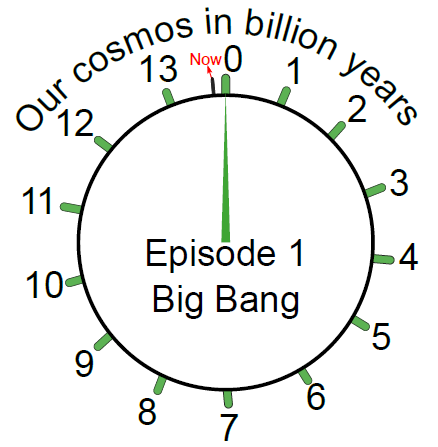
The Universe started 13.8 billion years ago. Only a few seconds after the origin of time, protons, neutrons, electrons and radiation had emerged from the original “primeval atom”. After 100 seconds, the protons and neutrons themselves into the first chemical elements: hydrogen, helium and traces of the lightest elements in Mendeleev’s periodic table.
The value of the helium to hydrogen ratio as observed today in the oldest stars of the Universe, provides one of many undisputable observational validations for the Big Bang theory.