
Extended information on episode 1: Three fiery minutes: the primeval furnace
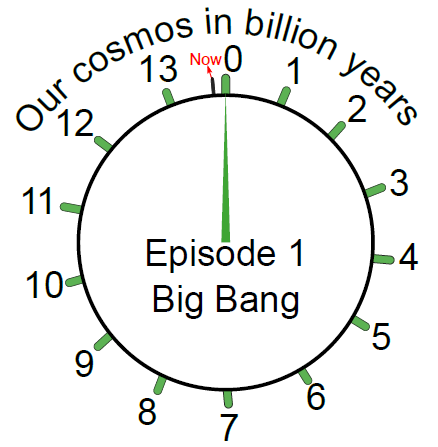
Some 13.8 billion years ago, this is when it all began, the history of our Universe. The Universe was born out of a a singularly unique quantum state. This mysterious state of essentially infinite density and temperature is beyond the reach of present-day fundamental theories. Out of that initial quantum state, called a singularity, emerged “at that unique moment, that knew no yesterday” both space and time, forever intertwined. The Universe was born, out of a “Big Bang”.
But neither did it “Bang” nor was it “Big”. Rather it was big in the tremendous release of energy thereby produced; and it was a unique and mindboggling firework of sorts, out of which “banged” all the particles and their interactions ever produced in the Universe, which ever since has but kept expanding without respite in all its distance scales. The expanding Universe was born.
Between that “unique moment” and 10-43 seconds into the Universe’s history, the quantum gravitational interaction must have reigned supreme, but that phase of the story remains a fundamental mystery of physics at the frontiers of knowledge today. Until 10-11 seconds, the gravitational force became more and more the feeblest of all the known fundamental interactions, the other such interactions then taking over one after the other to rule over the evolution of the Universe’s matter composition. During that period the Universe must have known a phase of tremendous exponential expansion. This so-called cosmic inflationary phase amplified any local geometric and energy fluctuations which, being subjected to the unavoidable spell of gravity, eventually became in their own time the seeds for the formation of large-scale matter structures in the Universe – galaxies and their clusters as they are observed today. This will be further explored in Episode 3.
Starting at 10-11 seconds, present day fundamental theories ensure a much more solid grounding to the story of the Early Universe. Here we reach energy scales that are being explored at high energy accelerators such as the LHC at CERN. These fundamental theories comprise not only Einstein’s theory of General Relativity for the gravitational interaction but also the quantum theories for the strong and electroweak interactions among all the fundamental particles – namely quarks, charged leptons and neutrinos – that have been established through Earth-bound experiments and observations.
Thus at 10-11 seconds it was the turn of the electroweak interaction to decouple, followed at 10-6 seconds by the strong interaction, thereby leaving over the electromagnetic interaction only to govern the further interactions of all the electrically charged matter that had been produced, namely quarks and leptons, while primeval neutrinos even then began to roam freely throughout the Universe like silent witnesses to its very early beginnings.
All the while expanding, the initially hot and dense Universe kept on cooling as well, as its total energy was being distributed over a steadily increasing volume of space. While it was still sufficiently hot, incessantly when scattering onto one another, pairs of photons were incessantly being converted into pairs of charged particles and antiparticles, which in turn through their own scattering annihilated one another to be converted back into pairs of photons. As long as its temperature stayed high enough while still expanding, the Universe was thus kept in a state of thermodynamic equilibrium, with so ever a tiny excess of matter over antimatter for a reason that still remains another physics mystery today. Yet it is from that tiny excess that all the matter existing in the Universe today has sprung into existence.
At some 10-6 seconds the Universe had cooled sufficiently for quarks to bind into protons and neutrons that could no longer be annihilated through proton and anti-proton pairs. The same fate awaited electrons and positrons at about 1 second into the history of the Universe. At that moment, its matter content was composed mostly of protons, neutrons, electrons and photons, given the tiny excess of matter over anti-matter with about 10 billion photons for a single charged particle. And all that tremendous transmutation of energy into matter through the action all four fundamental interactions occurred in just 1 second into the history of the Universe!
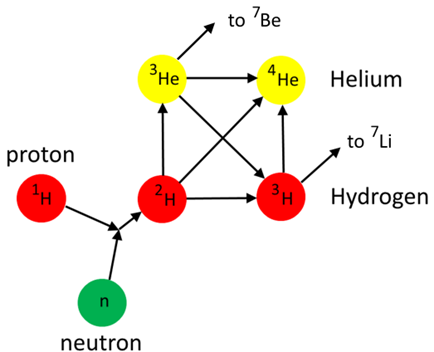
As the temperature kept decreasing, the first nuclear fusion reactions were triggered to produce bound states of protons and neutrons. In this Big Bang nucleosynthesis (see figure 1), nuclei other than those of the lightest isotope of hydrogen (1H, a single proton as a nucleus) such as deuterium (2H, an isotope of hydrogen consisting of a neutron bound to a proton), helium (He, two protons and one or two neutrons) were formed. This creation process stopped a couple of minutes after the Big Bang leading to 77% of hydrogen and 23% of helium and tiny traces of lithium (Li) and beryllium (Be). This is essentially the distribution of the primeval chemical elements of Mendeleev’s periodic table to be found in the very first generation of stars in the Universe. As will be explained in Episode 4, essentially all the heavier elements were created much later, by stellar nucleosynthesis in evolving and exploding stars.
This was the matter of affairs after only the first three minutes of the Universe’s history.
And for a long time, the soup of electrons, hydrogen and helium nuclei were interacting with a sea of electromagnetic radiation in the form of photons, being constantly absorbed and emitted by the charged matter particles. Until some 380.000 years after the Big Bang the Universe was cooled enough to undergo a drastic transition.