
Extended information on episode 2: A transparent universe: Let there be light!
And then at some 380.000 years after the Big Bang, the temperature decreased enough for the matter density to start dominating gravitationally over the energy density of the photon radiation, whose wavelength had been redshifted sufficiently to no longer be able to dissociate electrons from light nuclei. This recombination of matter thus led to the formation of the first neutral hydrogen (H) and helium (He) atoms. At this stage, radiation decoupled from matter and could henceforth continue to travel through space largely unimpeded by matter. The Universe had become transparent to electromagnetic radiation, bringing to us today as observers on Earth 13.8 billion years later, all the possible news of its infancy at the tender age of 380.000 years. Through light we can read back the history of the Universe up to 380.000 years after the Big Bang. With the recently discovered gravitational waves – a specific prediction of Einstein’s theory of General Relativity – we may now read back the history of the Universe up to just a fraction of a second after the Big Bang.
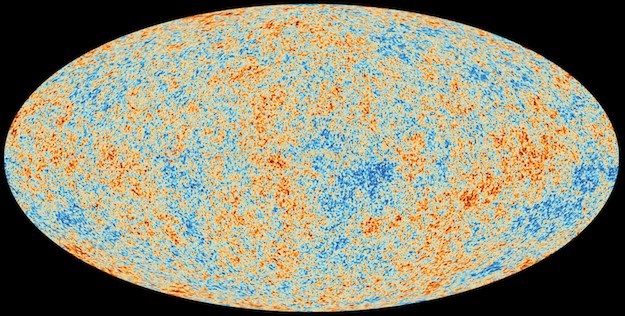
Because of the Universe’s expansion, this relic electromagnetic radiation has constantly been shifted to ever longer wavelengths, to reach today into the microwave frequency range with a frequency distribution characteristic of a black body at a fixed temperature, which is that of the Universe, some 2.73 kelvin (K) today, down from 3000 K at 380.000 years. This cosmic microwave background (CMB) radiation has indeed been observed as being emitted essentially uniformly from all directions of the sky. Yet its tiny relative fluctuations on the order of 10-5 (see Figure 1) carry most crucial information to unravel some of the deep secrets of the birth of the Universe through a Big Bang, in particular from during its inflationary phase. The Nobel Prize in Physics 2006 was awarded jointly to John C. Mather and George F. Smoot "for their discovery of the blackbody form and anisotropy of the cosmic microwave background radiation."
As a true visionary architect of modern physical cosmology and as the founder of the theory of the Big Bang, in 1927 Georges Lemaître had predicted that the Universe, rather than being static and immutable, is in fact expanding, and at the time Lemaître had even already estimated the Universe to be some 10 billion years old. Rewinding backwards in time this story so to say, in 1931 Lemaître also proposed his hypothesis that the Universe must have known a purely quantum beginning out of which both time and space must have emerged as a geometrical universe, and this from a quantum state of extremely large density and temperature. He referred to that initial quantum state as that of “the primeval atom” which then, by disintegration, produced in a most unique and singular fireworks all the matter content of the Universe, while at the same time leaving behind a trace in the form of some fossil radiation that should be detected today. In 1931, the observation of cosmic radiation brought Lemaître to thinking this was the expected radiation. However, it turned out that the observed radiation was coming from high-energy protons and atomic nuclei entering Earth's atmosphere. They originate from the sun or from outside of our Solar System. It was only in 1964 that the fossil radiation was discovered in the electromagnetic spectrum as the CMB radiation. Lemaître was informed of this discovery not long before he passed away on 20 June 1966.
The discovery of the CMB radiation provided another fundamental vindication of Lemaître’s ideas and proposals of the end 1920s. His ideas have become the essence of the theory of the Big Bang and of modern physical cosmology, with its initial quantum state for the geometry of space-time out of which emerged all of matter and radiation, and indeed, the Universe itself.