
Episode 3: The origin of stars and galaxies
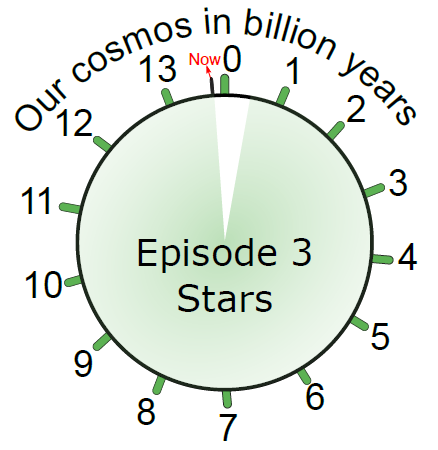
We all know the attractive spell of the gravitational force, as we have often experienced it since childhood. The small fluctuations observed in the cosmic background radiation points to small density variations in the otherwise homogeneously distributed matter after the Big Bang. It is gravity which will enlarge these small differences enormously. Hence within the almost homogeneous soup of matter and radiation making up the Universe after 380.000 years, any regions of higher matter density will eventually grow into stars, galaxies, and galaxy clusters.
Within the first billion years of the existence of time, the Universe began to adopt the familiar shape that humans have observed over the past millennia.
Inside stars, the internal pressure keeps increasing as their matter is brought ever closer through the action of gravitational pull. This results in a higher rate of collisions and higher internal temperature. Eventually the high temperature triggers the onset of nuclear reactions that produce energy and outward pressure which counteract the effects of gravity. The star reaches an equilibrium which lasts for as long as there is nuclear “fuel” matter available. The nuclear reactions cause the star to emit light. Stars go through their lifespan with burning cycles and nuclear chain reactions producing ever heavier chemical elements up to iron. In Episode 4, we will discover how the heavier elements are formed.
Stars are organised in galaxies. We observe that galaxies seem to be moving away from each other in a characteristic pattern. Actually relative to space itself galaxies are not truly moving. However, measured distances between points in space do change over time, because the Universe itself is expanding. The apparent recession of galaxies is the manifestation of the expansion of the Universe, not that of the proper motion of galaxies.
In 1927 Georges Lemaître was the first to predict precisely and in mathematical form the law which governs this recession of galaxies. The expansion of the Universe as a whole implies that the speed by which galaxies recede from one another is proportional to their relative distances.
In 1929 Edwin Hubble established this law experimentally through his survey and observations of galaxy redshifts. Lemaître’s prediction was unknown to Hubble.
The Hubble-Lemaître Law provides yet another undisputable observational validation for the Big Bang theory.