
Extended information on episode 4: And yes, we are stardust*

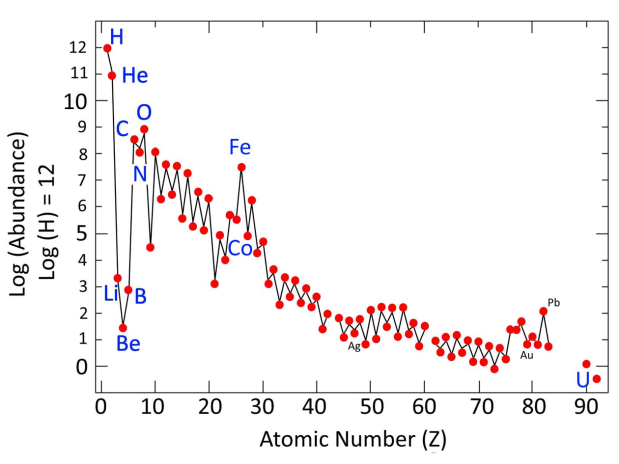
As we learned in episode 1, within three minutes after the Big Bang the first elements of Mendeleev’s Table were formed. The cosmic matter consisted essentially of 77% hydrogen (H), 23% helium (He) and some traces of lithium (Li) and beryllium (Be). Nowadays hydrogen (74%) and helium (24%) are still the most abundant elements in the Universe but as can be seen in figure 1, many other elements have been created.
* We are stardust, we are golden (Joni Mitchell, Woodstock 1969)
Where and when were all these elements formed?
The simple answer is "in the stars" and Joni Mitchell sings it right, we are stardust. But there is no unique production mechanism and no unique moment for the so-called stellar nucleosynthesis, the making of the elements. In fact stellar nucleosynthesis started with the first stars and is still going on.
Let's start from hydrogen. As can be seen from the percentage of hydrogen just after the Big Bang and the percentage in the Universe now, the amount of hydrogen decreased. In fact, hydrogen has and is being "burned" in stars, fusing into helium. In the proton-proton chain reaction four hydrogen nuclei (thus four protons) are converted into one helium nucleus, consisting of two protons and two neutrons. That's what our Sun is daily doing and where it gets its energy from, transforming 600 millions of tons of hydrogen into helium every second!
But stars can run out of hydrogen and another "burning" process starts where three helium nuclei are fusing into one carbon (C), jumping over the elements lithium (Li), beryllium (Be) and boron (B). That's why these last three elements are so rare in our Universe. Fred Hoyle , the British scientist who rejected Lemaître's theory and mockingly called it a "Big Bang", predicted in 1954 that, since he himself exists, there must be a doorway state in the carbon-12 (12C) nucleus where three helium nuclei can "meet". Without such a state, no carbon and no heavier elements could be formed. We would not be here neither. Soon after this prediction, the state was found and is still studied intensively.
But also the amount of helium to fuel the triple-alpha burning can get exhausted and another "burning" process can start. Carbon fuses with a helium nucleus forming oxygen (O). If the star is massive enough, which will not be the case of our star, the Sun, the story goes on, as long as energy is gained by capturing a hydrogen or helium nucleus, stars do shine and new elements are formed. Once iron (Fe), the most stable nucleus from a nuclear-physics point of view, is reached, there is no gain anymore in fusion and the "burning" process stops. Some stars explode leading to a magnificent supernova, a temporary new bright star. In the explosion, most of the material is blowing into space. This stardust can again be used in new stars.
Many interesting questions pop up by looking at the graph of elemental abundances in our Solar System. We will deal with two of them. An obvious one: where and how are the elements heavier than iron formed? And a more delicate one: how comes that oxygen is more abundant than carbon?
Elements beyond iron
The "burning" cycles are controlled by gravity. Gravity attracts mass towards the center of the star, the energy released in the nuclear process pushes mass outwards. This represents a control mechanism in a star, a process that can last for billions of years. Some of the elements heavier than iron are made in stars where iron is already present. Stars are gigantic nuclear "cooking" pots where stable and radioactive nuclei are present. Stable nuclei have a specific number of protons and neutrons that make them insensitive for radioactive decay. Radioactive nuclei have an imbalance between the number of protons and neutrons. The most important decay process for nucleosynthesis above the iron peak is beta-minus decay changing a neutron into a proton and thus going one unit in proton number up in the table of Mendeleev. Nuclei with an excess of neutrons will beta-minus decay. But where does the excess of neutrons come from? Some reactions in the burning cycles of the stars lead to free neutrons. A free neutron is radioactive and beta-minus decays into a proton. However its radioactive halflife (the time of which half of a group of neutrons have decayed) is about 10 minutes. So a neutron may be absorbed by a nucleus before it decays and this can lead to a neutron-rich nucleus. A stable iron nucleus can absorb a neutron and become radioactive. After beta-minus decay a cobalt (Co) nucleus is formed, one unit up in Mendeleev’s table. This nucleosynthesis process is called the s-process (s from slow) and occurs in stars over time scales of thousands of years. In the r-process (r from rapid), the neutron-rich nucleus has no time to beta-minus decay as the flux of neutrons is so high that it absorbs sequentially many neutrons, sometimes up to the line where the nucleus cannot hold the extra neutron any more. The r-process takes place in explosive conditions such as in supernova. After the explosion the very neutron-rich nucleus decays fastly and the endproduct is a nucleus many steps higher in the table of Mendeleev.
Oxygen, the life sustainer
Oxygen is the third most abundant element in the Solar System (see Figure 1). It is the most abundant element in the Earth's crust and it is, by mass, the highest contributor to the human body.
The matter in our Solar System (see the abundances given in figure 1) is formed from the ashes of many generations of stars all lighting up and fading away. Massive stars enriched with the dust of past generations are not "burning" hydrogen through the proton-proton chain reaction but through the much faster C-N-O cycle (see the outer ring in figure 2). Starting from carbon, a sequence of proton captures and radioactive decays lead to the "burning" of four protons into one helium nucleus and back to carbon, the catalyst. Later on in the star's life, after the hydrogen and helium "burning" cycles, the carbon "burning" into oxygen converts efficiently most of the carbon leading to a higher abundance of oxygen, which explains why there is more oxygen then carbon.
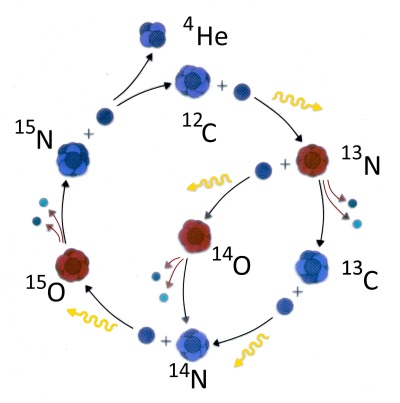
How do we know all this? This is the result of a collaborative effort between nuclear physicists and astrophysicists. In fact, all the processes seen in the outer ring of figure 2 have been measured here on Earth and the results have been used by astrophysicists in their stellar models. Next to this “cold CNO cycle”, there is also a hot CNO cycle. In certain stars with an extremely hot core, the radioactive nitrogen-13 (13N) has no time to decay to carbon-13 (13C) as the bombardment with protons is so intense that nitrogen-13 absorbs a proton leading to oxygen-14 (14O). Until 1991, a hypothesis as the proton-capture reaction on radioactive nitrogen-13 could not be measured here on Earth due to the short halflife of nitrogen-13. It is in a collaboration between the universities of Louvain-la-Neuve (UCLouvain), KU Leuven and Brussels (ULB) that for the first time a radioactive ion beam could be produced at stellar energies and the absorption of a proton by nitrogen-13 could be observed, fulfilling a request from William Fowler expressed in his Nobel’s Prize lecture *. This experiment represented the birth of a new research field of radioactive ion beams that is now blossoming all over the world leading to vigorous research in nuclear physics, in nuclear astrophysics and in material- and life sciences.
The European Physical Society (EPS) honours this breakthrough by awarding the location where these events happened the prestigious EPS Historic Site Award and to include it in the list of EPS Historic Sites, these are places in Europe important for the development and the history of physics. There are only two other EPS historic sites in Belgium: the Hotel Metropole in Brussels ('In 1911, the Hotel was the venue of the Solvay Council, dedicated to what soon would be called “The Theory of Radiation & Quanta” ' ) and the Heilige-Geest college in Leuven (“Georges Lemaître, original founder of the theory of the Big Bang, developed in this college his ideas about an expanding universe consistent with theory and observations”).
To celebrate this event, a commemorative plate has been unveiled on Tuesday 12 October 2021 at the "de Hemptinne" building of UCLouvain, which hosts the Cyclotron Hall.
* "It is my view that continued development and application of radioactive ion-beam techniques could bring the most exciting results in laboratory Nuclear Astrophysics in the next decade. For example the rate of the 13N (p, g) 140 reaction, which will be studied as 1H (13N, g) 140, is crucial to the operation of the so-called fast CN-cycle." William A. Fowler Nobel lecture 8 December, 1983
< Previous Episode Next Episode >