
Extended information on episode 06: Planet Earth gets a Life and an Atmospherer
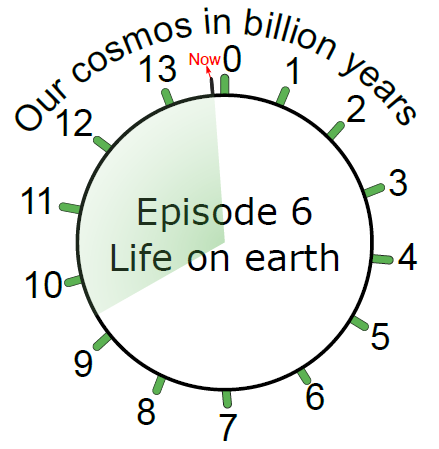
Life on Earth is built upon complex molecules mainly made of carbon, hydrogen, oxygen, nitrogen, phosphorus and sulphur. The so-called biomolecules assemble in complex molecular machines and are confined by membranes which delimit the cells, the basic units of life, whether organisms are unicellular or multicellular. A striking observation is that the components of life on Earth are universal, which means that all living organisms share the same basic molecules and molecular reactions that allow cells building up new biomolecules from what they can extract from their environment, generating energy via their metabolism, dividing and transmitting the information required to reproduce the functions of cells generation after generation.
When, where and how life appeared remains a matter of intense debate. What is clear now, is that basic organic molecules are abundant in the Solar System and most probably in all stellar systems. However, the transition of prebiotic chemical reactions leading to organic molecules, building blocks and functional polymers on Earth, and the assembly of molecular systems capable to reproduce themselves has been critical to launch life. Possibly several metabolic systems could have appeared without success. But what can be inferred from the universal organization of life on Earth is that all living forms derive from a common ancestral form of, probably RNA-based, life we do not have any trace of but must have pre-existed to all microbes, animals, plants and fungi which make up the current biodiversity.
Dating the origin of life on Earth is conjectural, some remnants of sediments which have been suggested as the byproducts of living organisms have been dated back to 4.28-4.77 billion years ago (microfossils in the ”Nuvvuagittuq Greenstone Belt” of Northern Quebec). The living origin of these traces however remains controversial. Some of the first unanimously admitted rests of living organisms have been dated to 3.48 billion years ago (Dresser Formation, Western Australia: microfossils and stromatolites).
Life deployed on Earth at an uncertain pace. Organisms have been unicellular or colonial for most of Earth’s history. Multicellularity independently appeared numerous times in the history of life. The oldest forms of multicellular organisms have been traced back to at least 3,0 billion years ago. True multicellular organisms, capable of regenerating from reproductive cells presumably arose about 800 million years ago.
A major event occurred with the appearance of photosynthesis, which consists in the ability to capture the energy of solar light and to use this energy to build up organic molecules from inorganic nutrients. A major consequence of photosynthesis is the production of di-oxygen, O2. This also occurred early during the evolution of life without major impact on the environment. With time however, di-oxygen accumulated and drastically modified the atmosphere around 2,45 billion years ago (this is referred to as the Great Oxygenation Event). As a consequence, life also evolved, giving rise to aerobic metabolism, i.e. to living forms able to convert nutrient energy into ATP by using di-oxygen molecules as oxidizing agent.
For a while life remained aquatic, but most probably microbes colonized continental environments rather soon after the appearance of life in water. Comparison between current bacteria allowed scientists to infer that the early colonization of land by bacteria might have occurred as early as between 2.8 and 3.1 billion years ago. In contrast, evidence for land plants and animals dated quite later, to the Ordovician period, between 488 to 444 million years ago.
For animals, a burst of diversification has taken place about 540 million years ago. This has been called the Cambrian explosion. It corresponds to the appearance of all the major groups of animals still existing today, an important branch which gave rise to worms, crustaceans, insects, another important branch which evolved towards snails, squids, octopuses and the last branch which led to the deployment of sea stars, sea urchins and ultimately of vertebrates including fishes, birds, mammals, …
All these groups of animals which appeared in water later colonized terrestrial niches. The most popular water-to-land transition concerns the amphibians which kept a partly aquatic and partly terrestrial way of life. Vertebrates with a complete terrestrial adaptation underwent an evolutionary transition towards a dry and corneous skin avoiding water loss. The water-to-land transition of amphibians took place over 340 million years ago, which corresponds to the age of fossils attributed to the truly terrestrial vertebrates with four legs (or tetrapods). Remarkably, since then several purely land animal species have evolved into new species that returned to water, like marine mammals. A critical element to keep in mind in the history of life is that during these long periods, continents were moving, and they still do. Consequently, some submarine environments became aerial when tectonic plates collided. This is why we now find submarine living species in fossil carrying layers in mountains in the middle of our current continents. The evolving configurations of oceans and lands provide explanations about the way living forms spread over time. For example, marsupials are endemic in South America and Australia, continents that are separated by thousands of kilometers today, but that were connected 44 million years ago when these species arose and spread.
While life evolved giving birth to novel characteristics and traits, we use to classify living species into classes, groups, genera or species, living forms also disappeared. Natural history met five mass-extinctions of living species. The most important one corresponds to the Permian-Trias transition, 251 million years ago, known as the ‘Great Dying’. We estimate that about 95% of the living species disappeared. The most popular mass-extinction is associated with the extinction of the large dinosaurs 66 million years ago. These mass-extinctions have been caused by major perturbations of the environment, caused by cataclysms like the impact of large meteorites like that which occurred 66 million years ago in what is now the Gulf of Mexico.
To focus on our lineage, the first mammals appeared before 220 million years ago (age estimated from the most ancient mammalian fossil record), thus far before the extinction of the large dinosaurs. These mammals were small, most probably nocturnal species. Most groups of the first mammals are now extinct. The groups we know now, which are characterized by so called modern traits appeared later, for most of them at the Paleocene-to-Eocene transition, some 56 million years ago. Older remnants of rodents have been identified, but fossils of carnivores and ungulates, for example, have not been found before this transition. The same holds for primates, the origin of which has been dated back to 56 million years ago. Our oldest ancestor, Teilhardina, conquered all the northern continents during an extremely warm period, known as the Paleocene-Eocene Thermal Maximum (PETM). The first fossil of this earliest primate was discovered in Dormaal by Teilhard de Chardin, after whom the fossil species has been named. The lineage of the great apes gave rise to the human species probably more than 7 million years ago. This is indeed the age that has been estimated for Toumaï, the Sahelanthropus tchadensis remnants, the oldest human specimen identified to date. From 7 million years to 1.9 million years ago, species of human beings like Orrorin, Ardipithecus, or Paranthropus, as well as the Australopithecus species diversified and most disappeared, all confined to Africa. We think Homo erectus was the first to leave its home continent to spread all around the world. Homo sapiens probably appeared 300.000 years ago in Africa. The oldest remnants of a Homo sapiens specimen have indeed very recently been discovered in Morocco (prehistorian site of Djebel Irhoud). Homo sapiens also deployed in Africa first before leaving his homeland about 120.000 years ago. Homo sapiens met other human species while spreading around the world… met and hybridized. Recent genetic data indicate that the genome of modern humans contains significant portions of the genetic legacy of Homo neanderthalensis. Whether neanderthals and sapiens define distinct human species or not is therefore questionable. What caused the extinction of neanderthal and all of the other human species (or sub-species) remains controversial and hypothetical. Nevertheless, these last 35.000 years we, Homo sapiens, have been the sole human species on earth. Of note, while looking at the current genetic diversity of the human beings from all countries, it has been inferred that at some point about 70.000 years ago, our species went through a populational bottleneck with only about 10 to 30 thousand human beings on Earth. This recent genetic bottleneck in human pre-history however remains controversial. Nonetheless, that the human lineage which appeared more than 7 million years ago could have become extinct about 70.000 years ago, as did other human species before as well as many living species since the beginnings of life, tells us how vulnerable living forms on earth can be, despite billion years of persistence and evolution of life on our small planet.
< Previous Episode Next Episode >