Extended information on episode 8: The final destiny?
In 1972 the American astronomers Carl Sagan and George Mullen formulated the ‘Faint Young Sun Paradox’. During its main-sequence lifetime (i.e. while it is using hydrogen as fuel), our Sun gradually brightens. In the early days of our Solar System, our Sun was only 70% as bright as today. With the current concentration of atmospheric greenhouse gases, the early Earth would have been too cold to hold any liquid water at its surface. Geologists have, however, found ample evidence in the geological record that already more than 3.5 billion years ago sediments were deposited in seas and oceans. The solution to this paradox lies in a changing atmosphere. The early atmosphere of the Earth was much richer in greenhouse gases than today’s atmosphere. This resulted in temperatures enabling the existence of liquid oceans from the earliest days of our planet’s history, even with a much weaker Sun. Since then, our living planet managed to keep the global planetary conditions within a relatively narrow range, suitable to allow life on Earth to thrive, despite the ever-increasing brightness of our Sun, delivering more and more energy into Earth’s system. Life on Earth itself is responsible for transforming Earth’s atmosphere, not only by oxygenating the atmosphere through photosynthesis, but primarily by sequestrating atmospheric carbon dioxide in biogenic carbonate rocks. Just think about it the next time you admire the beautiful ornamental limestones in our historical buildings … it is just sequestrated atmospheric carbon dioxide.
Greenhouse gas concentrations and in particular carbon dioxide levels have varied widely through the ages. Sequestrating atmospheric carbon dioxide for billions of years, , life on Earth left our atmosphere today with a concentration of greenhouse gases lower than it would have been without the existence of life on Earth. And this continuing sequestration of atmospheric carbon dioxide will eventually seal Earth’s fate.
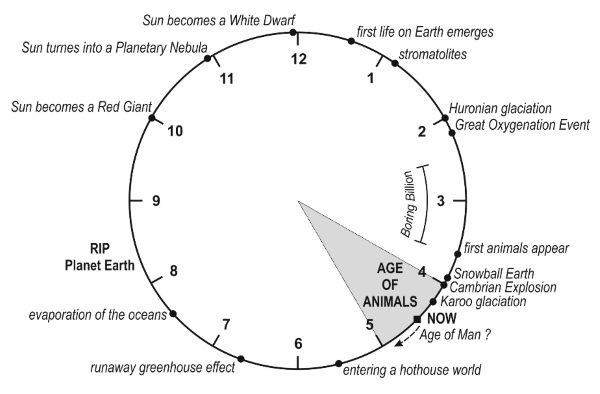
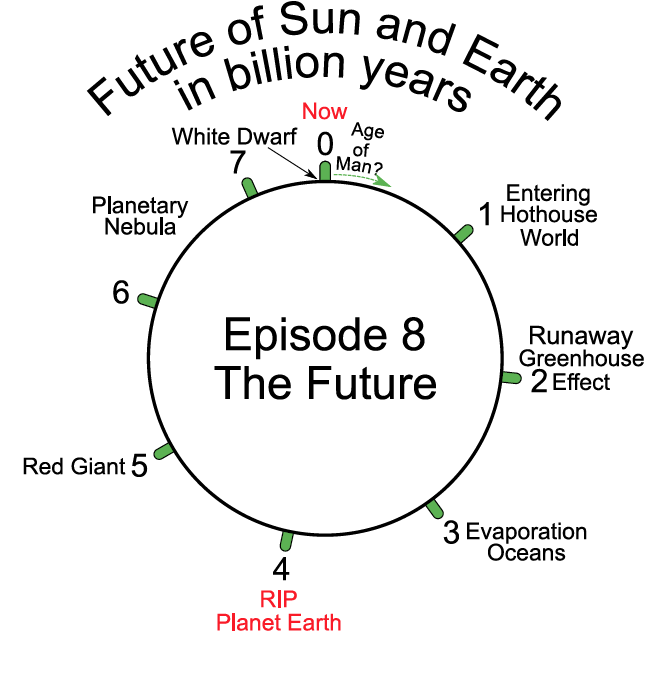
Our planet’s fate is indeed inextricably bound to the fate of our Sun. As a medium-size, main-sequence star, our Sun has a life expectancy of about 10 billion years. We are today nearly halfway. Some 5 to 8 billion years from now, our Sun will grow into a red giant, probably scoring Earth out of existence. But Planet Earth’s fate will be sealed much earlier. The brightness of the Sun will continue to increase by about 1% every 100 million years. Counterbalancing the ever increasing energy input of the Sun, Planet Earth will desperately try to clear the atmosphere from greenhouse gases through weathering and biogenic sequestration. This will lead to a carbon dioxide concentration that is too low for the current forms of photosynthesis. All photosynthesizing organisms will suffocate, starting off a cascade of processes that inevitably will lead to a system breakdown and eventually a runaway greenhouse effect. The end of photosynthesis, our main source of atmospheric oxygen, will subsequently, in less than 4 million years, lead to the disappearance of atmospheric oxygen through oxidation. All life depending on cellular respiration will suffocate as well. Some 500 million years from now, one billion years after the Cambrian Explosion that started the unique experiment of multicellular life, the age of multicellular organisms will come to an end. Anoxic bacterial life will have retreated to the depths of our oceans, far away from the ever more hostile environment at the Earth’s surface.
One billion years from now, receiving some 10% more Solar energy than today, temperatures will be so high that oceans will start to evaporate, eventually resulting in a scorching hothouse world, pushing the runaway greenhouse effect to extremes. Some two billion years later our planet will be dried out completely. Any lifeform would have vanished by then. Plate tectonics would cease, being impossible on a dry planet. Just like Venus today, our planet will be dead, suffocating in a dense hothouse atmosphere, orbiting a very bright Sun approaching the end of its lifecycle.
Some 5 billion years from now, the Sun will indeed have fused all the hydrogen in its core, ending its main-sequence life. The Sun will first enter its red giant phase, eventually ending some 2 billion years later as a white dwarf. From that moment on our Sun, if we can still call it that, will lead a very monotonous life of gradual cooling and fading … to the end of times.
Eventually our expanding Universe will not escape its fate, inevitably obeying the second law of thermodynamics. Entropy will increase to the point that all gradients disappear. Our Universe will have reached its ‘heat death’. It will be – literally – the end of time.